Play versus work: A simple mindset shift that increases capacity and enjoyment
tl;dr: After reading this, you will be able to understand the power of changing your mindset towards a play orientation to make your tasks lighter, more enjoyable, more creative.
Since I was a child, I have focused on what makes me feel alive.
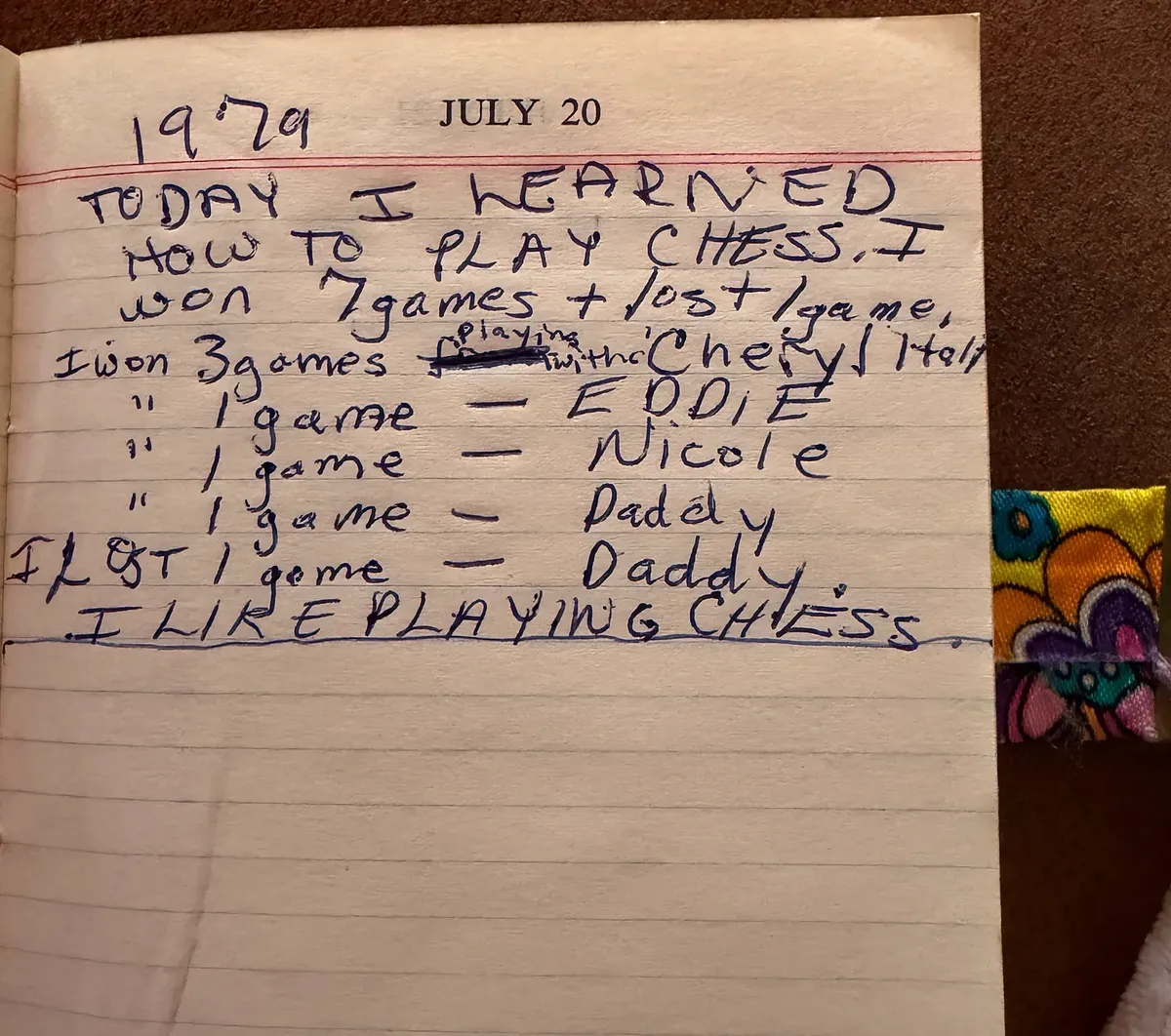
My childhood diaries attest to that. I wrote down moments of great joy, sadness, fear, and excitement. Life seemed to be perpetually interesting.
Diary entry from 1975 about being scared and excited to become a Brownie
Diary from 1979 showing excitement at learning to play chess.
As I’ve grown older, with more responsibilities and a history of losses, failures, illnesses, and other sorrows, I’ve found life feeling heavier as well. Sometimes, it has felt so heavy that just to start the day felt like a burden.
And yet, there is an attitude that helps me be present and more alive to the moment, even if it’s a difficult one. It is an attitude of “play.”
And when I remember it, it is a powerful key that unlocks greater joy, openness, curiosity, and enjoyment in my life. It counteracts the heaviness with an attitude of experimentation and lightness, subverting the “shoulds” and “have tos” that all too often plague us as adults.
What I mean by play is not frivolous, giddy, or light-hearted. I mean, it could be, but it could also mean playing with being focused, being serious, being deliberate.
It’s an attitude and not an emotion.
The point is the mental perspective underneath the action. It’s oriented in curiosity and openness to experimentation. Not taking oneself too seriously. Having a sense of wonder.
Switching my perspective to one of play has helped me get unstuck, increased my enjoyment of unpleasant chores, and unleashed creative solutions to dilemmas I’ve faced.
Example #1
Once, when I was meditating in my room, I heard my teenager’s alarm going off. I was irritated at the noise. My son doesn’t wake easily, so he sets multiple loud, annoying alarms to repeat at various intervals over the course of 30 minutes each morning. It was impossible to focus.
As the alarms continued, my irritation increased, and part of me wanted to stomp over there and yell at him to turn off the alarm. Instead, I thought of play: I wondered how I could play with the act of walking to his room and asking him to turn off the alarm.
Hmm, perhaps I could bear crawl across the house to his room? This would feel good in my body and further help prepare me for meditation. Just as I started to bear crawl, my son turned off the alarm, and I returned to my meditation.
What was so cool about this was that I didn’t “leave” myself to go stomp across the house and then return to myself on my meditation cushion. Rather, I was with myself the whole time, so the moment didn’t pose an interruption to my meditation and prayer time. It was part of it.
What if I treated all “interruptions” like this? Not as events outside my narrative of the day, but as worth being present for as well?
Lecturing to myself to “be present” doesn’t work for me though. This just inspires the rebel in me. However, the idea of playing with the moment is much more fruitful (and fun).
Example #2
I was in grad school, working towards my doctorate, and faced with writing my fourth analytical essay for a psychology class in my first year of studies. I was burned out on thinking and writing this late in the semester, and I didn’t feel like I had anything to say on the topic. I faced the blank page with severe writer’s block and impending panic at the rapidly approaching due date. Then, I remembered my Vygotsky readings, and decided to turn the assignment into play. What would make this fun, I wondered. Oh, what if I wrote a letter to my mom explaining what I had been reading and learning? She doesn’t understand what I’m studying, so this would be a good opportunity to share my school experience with her.
And so I began, “Dear Mom….,” and I proceeded to write a very simple essay about very complicated research. And I turned it in as is, with a note to my professor that I had experienced writer’s block, so I chose to write the essay in the form of a letter to my mom.
And it worked! My prof said the essay was my best yet, and I felt like I was beginning to understand how to translate vague constructs into clear, practical ones.
Evidence
Vygotsky, the famous Russian developmental psychologist, thought play was a powerful means of trying on behaviors that were just beyond our reach. Through play, we can extend our “zone of proximal development” BEYOND what we are capable of doing on our own.
This idea has been borne out by research. For instance, young children are often unable to stand still for more than a few minutes. But if you tell them that they are sentries standing guard over a treasure and must not move, then they can stand still for much longer than they could otherwise. In fact, their performance during play is akin to that of children two years older! 1
The Sweet Spot
Play allows us to move beyond our current abilities. It doesn’t mean being silly (though it could!). It is an attitude of wonder and exploration based on what YOU find fun in the moment.
The Sandbox: Try This
The next time you are facing a chore or activity you are resisting, try reframing it as play. Ask yourself, how I can approach this situation with an attitude of play? Try it with exercise, or cooking a meal, doing the dishes, or listening to your child’s long-winded explanation of a YouTube video. Or writing a Substack article…. ✨Joy Highlights of the Week✨
I got to go hiking in the woods of Western North Carolina, and the mountain laurels were in bloom! They remind me of my childhood in upstate NY.